
Contents
- 1 From Prep Bottleneck to Productivity Boost with Automated Egg Peeling at KaiBa Mechanical Factory
- 1.1 KaiBa Company: Manufacturing High-Quality Quail Egg Peeling Machines
- 1.2 Introduction and Benefits of Using Machines from KaiBa Factory
- 1.3 Production Process: Detailed Stages with Specific Data
- 1.4 Why Choose KAIBA for Processing Over Other Units
- 1.5 10 Frequently Asked Questions and Detailed Answers
- 1.6 Contact KaiBa Company
From Prep Bottleneck to Productivity Boost with Automated Egg Peeling at KaiBa Mechanical Factory
Many food businesses—ranging from small catering companies to large-scale snack and pickled egg manufacturers—face a common bottleneck: preparing large volumes of quail eggs. Manual peeling is slow (often just 100–300 eggs per hour per worker), inconsistent, labor-intensive, and prone to high breakage (20–30%). This limits production capacity, increases costs, and prevents companies from capitalizing on rising demand for convenient, ready-to-eat quail egg products.
Automated egg peeling machines offer a direct solution, transforming this prep bottleneck into a major productivity boost. KaiBa Company’s advanced quail egg peeling systems automate the tedious shell removal process, delivering high speed, low waste, and reliable output. Businesses using these machines report 5–10× faster processing, reduced labor needs, and consistent quality that supports scaling operations.
This article explores how KaiBa’s technology turns preparation challenges into competitive advantages, with detailed insights into the company, benefits, full production process, selection rationale, and practical FAQs.

KaiBa Company: Manufacturing High-Quality Quail Egg Peeling Machines
KaiBa Company is a dedicated mechanical factory in Vietnam specializing in innovative food processing equipment. With a core focus on egg handling solutions, KaiBa designs, engineers, and manufactures reliable quail egg peeling machines that address real-world production bottlenecks.
Every machine is constructed from high-grade 304 stainless steel, ensuring food safety, corrosion resistance, durability, and straightforward cleaning. KaiBa offers a range of models—from compact semi-automatic units suitable for smaller businesses to fully automated industrial lines capable of handling hundreds of kilograms per hour.
By combining precision engineering, user-friendly controls, and energy-efficient components, KaiBa delivers practical, high-performance machines that help producers overcome prep limitations and achieve sustainable productivity gains.
Introduction and Benefits of Using Machines from KaiBa Factory
The shift from manual to automated egg peeling eliminates the classic prep bottleneck. Traditional hand-peeling struggles with quail eggs’ fragile shells and tight membranes, resulting in low throughput, variable quality, and excessive waste. KaiBa’s automated systems change this dynamic, processing 150–500 kg/hour (approximately 10,000–40,000 eggs/hour depending on model) with peeling efficiency of 98–99% and breakage rates below 2%.
Primary Benefits:
- Breakthrough Productivity: One machine delivers output equivalent to 10–20 manual workers, allowing businesses to meet large orders, expand product lines, or handle peak seasons without proportional staffing increases.
- Labor Cost Reduction: Cuts workforce requirements by 70–85%, freeing personnel for higher-value tasks like packaging, quality control, or sales.
- Waste Minimization: Gentle automated mechanisms preserve egg integrity, reducing material loss by up to 90% and improving raw material utilization.
- Consistent Product Quality: Uniform peeling produces smooth, intact eggs ideal for premium packaging, pickling, canning, or direct sale.
- Faster Turnaround: Shortens prep time dramatically, enabling quicker order fulfillment and better inventory management.
- Operational Reliability: Designed for continuous use with minimal downtime, supporting 24/7 production when needed.
- Hygiene & Compliance: Enclosed stainless steel systems reduce contamination risks and align with food safety standards.
- Scalable Investment: Affordable models grow with business needs; most users achieve ROI within 6–12 months through higher output and lower costs.
Producers adopting KaiBa machines transition from struggling with prep constraints to confidently boosting overall productivity and market reach.
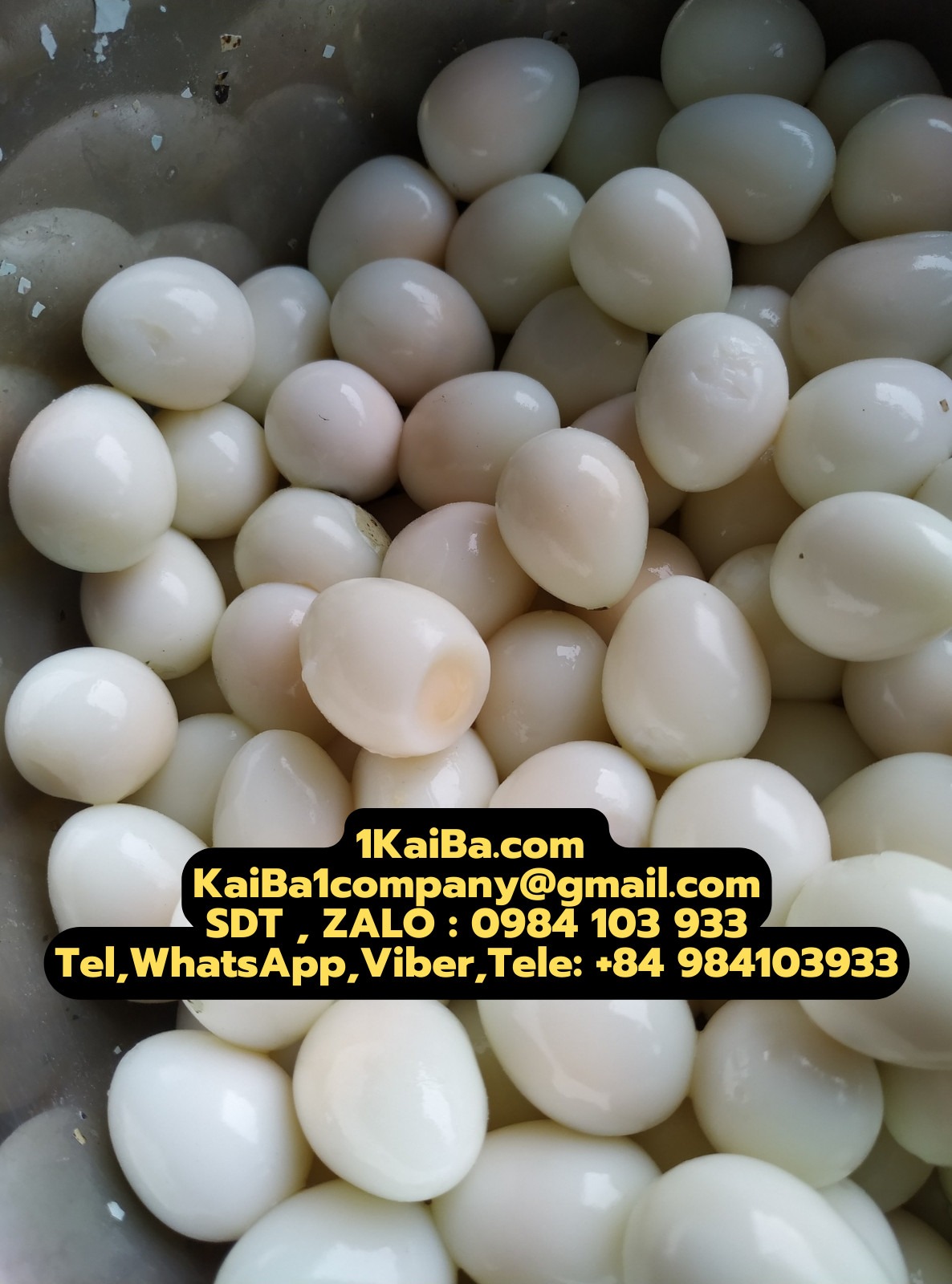
Production Process: Detailed Stages with Specific Data
KaiBa’s automated egg peeling machines perform best within integrated lines that handle the entire workflow from raw eggs to peeled product. The following outlines each stage with precise parameters drawn from KaiBa’s standard high-capacity models (200–500 kg/hour throughput).
1. Egg Intake & Prewarming
- Fresh quail eggs (ideally 3–10 days old) loaded into hopper or soaking tank.
- Warm water immersion at 35–45°C for 15–25 minutes.
- Softens inner membrane and prevents thermal shock cracking.
- Capacity: 500–800 kg/hour.
- Impact: Reduces early-stage breakage by 45–60%.
2. Automated Boiling
- Conveyor feeds eggs into temperature-controlled boiling chamber.
- Cooked at 98–100°C for 7–14 minutes with gentle agitation for yolk centering.
- Ensures consistent texture and shell looseness.
- Throughput: 300–1,000 kg/hour.
- Fully automated—no manual handling.
3. Rapid Cooling
- Immediate transfer to chilled water spray or bath (2–8°C) for 10–20 minutes.
- Contracts egg contents, creating separation gap.
- Membrane detachment: 94–97%.
- Breakage rate: <1.5%.
4. Precision Cracking
- Eggs enter adjustable roller or drum cracker.
- Applies uniform micro-pressure for controlled shell fractures.
- Optional brief post-crack soak.
- Capacity: 400–600 kg/hour.
- Additional damage: <1%.
5. Core Automated Peeling
- Eggs processed in rotating chamber featuring rubber hoses, sponge pads, and adjustable water jets.
- Friction combined with hydraulic action removes shells efficiently.
- Peeling success rate: 98–99.5%.
- Processing speed: 200–500 kg/hour.
- Shells automatically separated via vibrating trays or conveyors.
6. Final Separation & Discharge
- Peeled eggs rinsed and conveyed to output area.
- Shell fragments collected separately.
- Optional air drying or final inspection.
- Usable intact yield: 97–99%.
7. Downstream Integration
- Seamless connection to marinating tanks, vacuum packaging, or grading stations.
- Complete line: Processes high volumes end-to-end with only 1–3 operators.
This efficient, automated sequence converts raw input into market-ready peeled eggs, eliminating bottlenecks and driving productivity.

Why Choose KAIBA for Processing Over Other Units
When upgrading from manual prep to automation, KaiBa provides distinct advantages over generic or competing solutions:
- Optimized for Productivity Gains: Real-world performance of 98%+ peeling and <2% breakage consistently outperforms many lower-spec machines.
- Superior Build Quality: Full 304 stainless steel construction ensures longevity, hygiene, and ease of maintenance compared to mixed-material alternatives.
- Practical Customization: Tailored capacities and modular designs fit specific business needs—not rigid, one-size-fits-all imports.
- Strong Value Proposition: High efficiency at competitive pricing, delivering faster ROI than premium or underperforming options.
- Direct, Responsive Service: Immediate support via WhatsApp, readily available parts, and clear warranties—better than distant suppliers.
- Proven Track Record: Expertise across egg, coconut, and aloe vera processing lines demonstrates reliable engineering.
KaiBa delivers the practical upgrade businesses need to turn prep bottlenecks into lasting productivity boosts.
10 Frequently Asked Questions and Detailed Answers
- How does automated peeling eliminate the prep bottleneck? It processes 150–500 kg/hour versus manual 100–300 eggs/hour per person, removing capacity limits.
- What productivity increase can businesses expect? Typically 5–10× higher output with one machine replacing multiple workers.
- How much labor cost is saved? 70–85% reduction—often 1–2 operators handle what required 10–20 staff.
- What breakage rate occurs with KaiBa machines? Usually under 2%, compared to 20–30% manual, thanks to gentle automation.
- Do eggs need boiling before peeling? Yes—optimal results require hard-boiled, cooled, cracked eggs; full lines include these.
- How hygienic and easy to clean are the machines? Food-grade stainless steel with open design allows fast, thorough cleaning daily.
- What power consumption do they have? Low-wattage motors (18–30W) keep electricity costs minimal even at high throughput.
- Can the machine adapt to different egg sizes? Adjustable settings handle natural quail egg variations effectively.
- How long does setup and operator training take? Installation in 1–3 days; simple controls with training enable quick startup.
- Is the investment worthwhile for growing businesses? Yes—rapid ROI from higher yield, lower waste, and labor savings supports expansion.
Contact KaiBa Company
Ready to boost your productivity? Contact us:
KaiBa Company Phone Number/WhatsApp: +84 984103933
Click on WhatsApp: http://wa.me/+84984103933
Email: [email protected]
Website: http://1kaiba.com
Specialized Sites:
- Coconut Machine: https://machinecoconut.com
- Aloe Vera Machine: https://aloeveramachine.com
- Egg Machine: https://eggpeelmachine.com
- Quail Egg Machine: https://quaileggmachine.com
Vietnam Sites:

